
Au Pair vs. Nanny in Washington, DC: What Families Here Actually Choose
Every few weeks a parent in Washington DC reaches out after spending a few nights reading au pair forums. They've compared the stipends. They've measured the spare bedroom. Most end up choosing a nanny. This is the honest comparison they needed before starting the search, with the numbers DC families are actually dealing with in 2026.
Quick answer: Au pairs cost less per month but cap your hours at 45 per week, require a private bedroom in your home, and run on a J-1 visa with an expiration date. Nannies cost more monthly but give you full scheduling control, don't need a spare room, and can stay for years. Most DC dual-income families land on the nanny. Here's why.
What an Au Pair Actually Is
An au pair is a young adult, typically 18 to 26, on a J-1 cultural exchange visa. They live in your home. Federal rules set a hard cap at 45 hours of childcare per week and 10 hours in a single day. The minimum weekly stipend in 2026 is $221.85, though most DC host families pay $250 to $350 to stay competitive. That's not the full picture. You're also responsible for a private bedroom, meals, up to $1,000 per year in educational costs, and round-trip travel. A lot of families go in expecting a budget option and come out surprised by the real annual total.
Visa: J-1 cultural exchange, requires a State Department-approved sponsor organization
Hours cap: 45 per week, no more than 10 in a single day (federal requirement)
Minimum stipend: $221.85 per week in 2026
Housing: private bedroom required; shared bathroom is acceptable
Program length: 12 months, extendable to 24 with the same or a different host family
What a Nanny Brings That an Au Pair Can't
A nanny is a household employee. You write the agreement, set the schedule, and define the duties. There's no visa clock. No host-family obligations. No federal cap on how many hours she can work in a given week. Full-time nannies in Washington DC earned $28 to $42 an hour in 2026. Infant care, special-needs experience, and teaching backgrounds tend to sit at the higher end of that range.
That's a bigger monthly number than an au pair stipend. Worth knowing: the right nanny placement can last three or four years. And unlike an au pair, a nanny can work any schedule you both agree to. Forty hours, fifty hours, occasional Saturdays. If you need coverage for a last-minute trip or an early-morning flight, that's a conversation, not a program violation. Long-term childcare stability has real dollar value that the hourly rate doesn't show.

The Real Cost Breakdown
Run the annual numbers before you compare the two options.
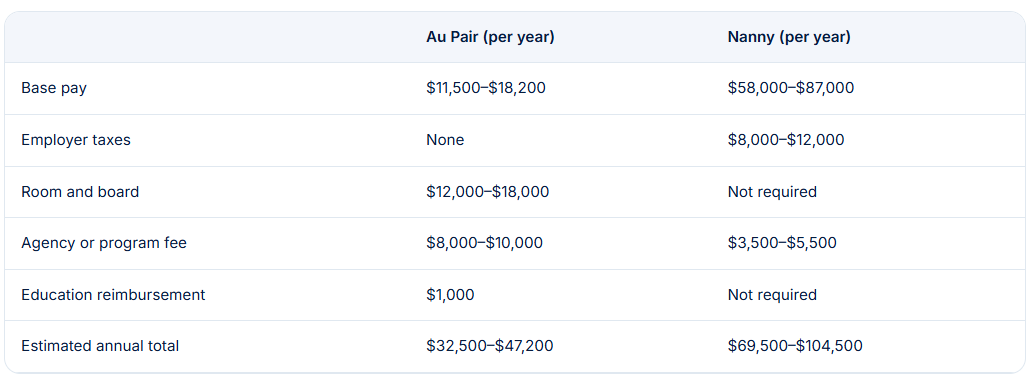
The gap is real. Au pairs run roughly half the annual cost of a full-time nanny. What the table doesn't capture: DC housing is expensive. A private bedroom in this city can cost $1,500 to $2,000 per month in opportunity cost alone. The total also doesn't include rematching fees if the au pair placement ends early, which run $2,000 to $4,000 depending on the program.
A family with two kids in a DC rowhouse and no spare bedroom is not the right fit for the au pair model. A family with three kids, a basement suite, and consistent 9-to-5 hours might be. For a closer look at what nanny employment actually costs line by line, nanny costs in Washington DC goes into the W-2 math in detail.
Hours, Scheduling, and the 45-Hour Cap
The federal cap is where most DC families run into trouble. Forty-five hours a week, 10 per day. That's the legal maximum for an au pair. Full stop. If you have early morning calls, evening client dinners, or a week of travel on the calendar, you're already past it. A nanny's hours are whatever you negotiate in the work agreement.
Part-time, full-time, overnight coverage, temporary help during a busy quarter. You can also bring in a temporary nanny for a specific stretch, something the au pair program doesn't allow. If your schedule is unpredictable, that flexibility tends to matter more than the monthly cost difference once you're actually living it.

Vetting and Background Checks
Au pair programs run background checks through their sponsoring organizations, but what those cover and how deep they go varies by program. You're often making a hiring decision after two video calls with someone you've never met in person. District Sitter runs every candidate through a 7-step vetting process that includes criminal background checks, child abuse registry searches, driving record reviews, and direct calls with former employers.
The result is that you know a candidate's history before they show up on the first day. When someone will be in your home with your kids 40-plus hours a week, the depth of that process is worth knowing before you commit to any placement.
What DC Families Usually End Up Choosing
Most dual-income households in Washington DC land on nannies, particularly when they have kids under five or unpredictable work schedules. The au pair model makes more financial sense for families with three or four kids (the per-child cost drops significantly), consistent 9-to-5 hours, and a genuine spare private bedroom.
When those three conditions don't all line up, the savings narrow and the scheduling constraints stay. Families who've done both arrangements tend to say the same thing: the au pair year was manageable, and the nanny placement was easier to run. That's not a knock on the au pair path. It's a specifics match.
If the numbers point to a nanny, the practical next step is finding one who's been properly screened. A DC nanny placement service handles the background checks, reference calls, and matching process so you're not doing it yourself at 11pm. If you also need coverage for evenings or weekend events without a full-time placement, the on-call babysitting service is a separate option a lot of DC families use alongside a nanny hire.
Au pairs aren't the wrong choice. They're a specific one with real constraints. Going in with the actual numbers and realistic expectations tends to produce better outcomes than forum comparisons do.