
How to Find a Part-Time Nanny in Arlington, VA Without Settling
Part-time nannies in Northern Virginia charge $25-$34/hr and are harder to fill than full-time slots. Here's the honest guide to a placement that actually lasts.
Quick answer: Part-time nannies in Northern Virginia typically work 20 to 25 hours a week at $25 to $34 an hour. They're harder to find than full-time candidates and often command a higher hourly rate. This post explains why and how to land one who actually stays.
Part-time nanny searches in Arlington look easy on paper. Post a job, get applications, pick someone. In practice, they're some of the trickier placements we handle. The candidate pool is smaller, the hourly rate runs higher than full-time, and the families who skip the prep work usually end up replacing someone at month six. Here's what the process actually looks like.
What 'Part-Time Nanny' Actually Means
Part-time nanny means different things to different families. Before you post a job, you need to know exactly what you're asking for.
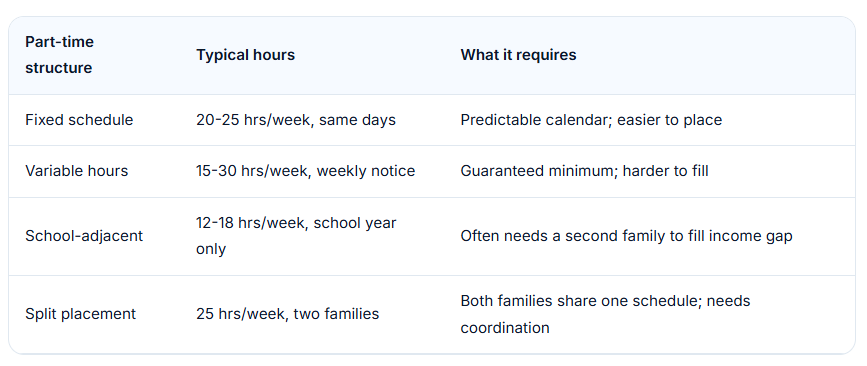
There's a difference between 20 fixed hours a week (Monday through Wednesday, 8am to 4pm, predictable), 25 variable hours a week (you text her by Sunday night with the week's schedule), and 15 school-adjacent hours that are really just drop-off, pickup, and a homework window. Each one requires a different candidate.
Variable scheduling is the hardest to place. A good nanny has other work offers. She won't hold blocks of time available for you to maybe fill. Guaranteed hours matter here more than in a full-time placement, because her income depends on the commitment you make.
Part-Time vs. Full-Time: The Real Cost Difference
Part-time doesn't cost proportionally less than full-time. It costs more per hour. That's not arbitrary. It's supply and demand.
Full-time nanny pay in Northern Virginia runs $22 to $32 an hour. Part-time typically comes in at $25 to $34, sometimes higher for experienced candidates with infant or toddler specializations. A full-time position is a stable career. Part-time is a piece of a career. Candidates who take it need to be compensated for the instability.
Add employer payroll taxes (roughly 9 percent of gross wages), guaranteed hours, benefits, and the annual raise and a 20-hour-a-week placement can run $35,000 to $45,000 a year all-in. Most families who budget only for the raw hourly rate get surprised when the real number shows up.

Why Part-Time Placements Are Harder to Fill
Here's the honest version of this.
A full-time position offers a nanny a full income, a clear routine, and professional stability. When we're placing candidates, full-time slots fill faster. The candidates with the strongest references and the best track records take full-time offers first.
Part-time positions tend to attract newer candidates, candidates in transition, or candidates who are intentionally splitting between two families. None of those are bad options. But you need to vet accordingly. A newer candidate needs more check-ins and structure in the first 90 days. A split placement needs a coordination system with the other family.
Budget more time for the search. Two to four weeks versus the standard one to two for full-time. And set your guaranteed hours before you post. Ambiguous offers don't attract the best candidates.
The Schedule Conversation You Need to Have First
Before you post the job or contact an agency, write out the exact schedule you need. Not an approximation. The specific days, the specific hours, any flexibility you're offering, and what 'flexibility' actually means on your end.
Most placement breakdowns happen because the family and the nanny had different assumptions about how the schedule would work. She thought flexible meant she could adjust start times occasionally. You thought it meant you could shift her days week to week. Two different things.
What are the fixed days and hours?
What notice do you give if the schedule changes in a given week?
What are the guaranteed minimum hours per week?
Is summer the same schedule or different?
Does the school year affect the hours?
What happens during school breaks or closures?
What a Trial Day Looks Like
A trial day (sometimes called a working interview) is a paid half-day or full day where the candidate works with your kids before an offer is made.
It tells you things a resume and a reference call can't. How she handles a transition between activities. Whether she reads your child's energy or runs the same script regardless. How she handles a minor meltdown. Whether she communicates with you during the day or goes quiet.
Pay for the trial day at the agreed hourly rate. This is standard and it matters. A candidate who shows up for an unpaid trial is often one who's been turned away from enough paid ones that she'll accept the condition. That's not where you want to start.

Making the Part-Time Placement Last
The families who keep part-time nannies for two or three years do a few things right from the start.
They set guaranteed hours and hold to them. They pay at the upper end of the Arlington range, not the lower end with vague promises of more hours. They run a real W-2 and handle payroll correctly. And they give enough notice when the schedule shifts that the nanny can plan her own week.
Part-time arrangements that feel like an afterthought produce nannies who treat the position the same way. Treat the role like the professional position it is and you'll keep someone good.
If you're ready to find a vetted part-time nanny in the Arlington area, our DC nanny placement service handles the search, the vetting, and the offer letter guidance. You meet a shortlist of candidates who fit your specific schedule. We handle the rest.