
Household Staffing in Arlington, VA: What Estate Managers, Household Managers, and Personal Assistants Actually Do
The call we get most often goes something like this: family in Arlington says they need a household manager. After about ten minutes, it turns out they actually need three different roles filled by three different people. Or they need one person, but that person's job description is a mess, half nanny, half housekeeper, half personal assistant, with a grocery run on Thursdays.
Household staffing is a real category with real role definitions. Getting those definitions right before you start hiring saves you six months of the wrong person in the wrong chair.
Quick answer: Household managers run the operational side of a home, vendors, scheduling, staff coordination. Estate managers do the same across larger or multiple properties. Personal assistants handle the family's logistics and admin. These are three distinct jobs. Packaging them all into one hire usually ends badly.
What Household Staffing Actually Means
Household staffing is the placement of professional domestic staff, people whose full-time job is running or supporting a private home. It's not a cleaning service you call on Fridays. It's not a nanny agency. It's a distinct category that includes household managers, estate managers, personal assistants, and sometimes private chefs, chauffeurs, or property caretakers depending on the household's scale.
Families in Arlington typically come to household staffing one of two ways: either they've grown past what a housekeeper and a nanny can handle, or they've experienced enough broken-down logistics, missed vendor appointments, scheduling gaps, the mental load of managing a house on top of two demanding careers, that they decide to professionalize. Both are legitimate entry points. The role you hire for depends on what's actually falling apart.

The Household Manager: What They Run and What They Don't
A household manager runs the operational layer of a home. That means coordinating vendors, managing the housekeeper's schedule, overseeing maintenance and repairs, handling household purchases, and keeping the property running the way you want it to run without you having to manage all the moving pieces.
What they don't do: raise your kids, provide personal childcare, or act as a floater who fills in wherever the schedule has a gap. That's a common misunderstanding, and it's where placements go sideways. If you also need childcare, that's a nanny or a babysitter, a separate hire. If you're wondering how those roles interact, the household manager vs. senior nanny comparison breaks down the line between them.
Estate Managers: Larger Properties, More Complexity
An estate manager does what a household manager does, but at scale. Think multiple properties, a full-time domestic staff team of four or more, significant vendor relationships, and sometimes seasonal operations across different residences. The role requires strong HR instincts on top of operational management, you're hiring someone to manage staff, not just coordinate services.
In Arlington and the broader Northern Virginia corridor, estate managers typically come into the picture when a family has a primary residence plus a vacation property, or when the household's annual operating budget gets complex enough to need someone with a financial management background in addition to operational skills. It's a senior role with a senior price tag.

Personal Assistants in a Private Home
A household personal assistant is different from a business PA, though the overlap confuses families who have experience with corporate assistants. In a private home, a PA handles the family's logistical and administrative load: travel booking, calendar management, RSVPs, returns and exchanges, managing school enrollment paperwork, appointment scheduling, sometimes errands.
They're not running the house operationally, that's the household manager's lane. They're managing the family's time and workflow. In a busy dual-career household in Arlington, especially one with school-age kids and a heavy social or civic calendar, a good PA frees up 8 to 12 hours of mental bandwidth a week. That's the real metric.
What Pay Looks Like in Arlington in 2026
These are real ranges, not wishful thinking:
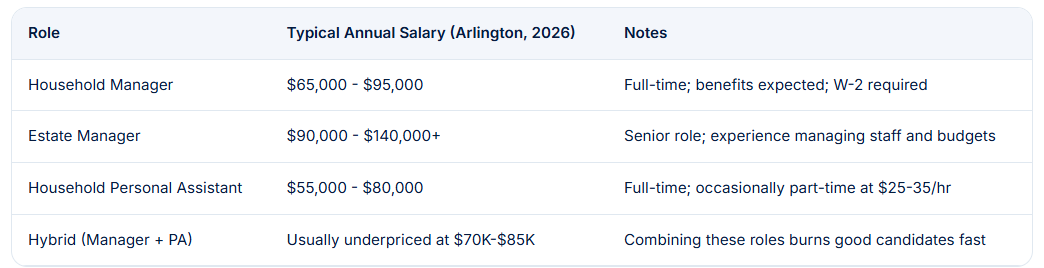
Paying under the table for these roles carries the same legal exposure as underpaying a nanny. The IRS treats household employees as employees, not contractors. Both the family and the staff member end up worse off when payroll isn't run correctly.
How to Know Which Role You Actually Need
Start with what's actually broken. Is the house operationally chaotic, vendors not showing, maintenance deferred, the housekeeper not being managed well? That's a household manager problem. Is your own calendar and administrative load overwhelming? That's a PA problem. Are you managing multiple properties across different states? That's an estate manager conversation.
If the answer to all three is yes, you likely need a small team rather than one person doing three jobs. One person doing three jobs will leave inside a year. Every time. Start with the role that addresses your biggest friction point first, get that working, then build. For families ready to explore their household staffing options, a staffing consultant can help map the right structure before you post a job description.
Operational chaos (vendors, maintenance, staff coordination) = Household Manager
Calendar, admin, logistics overload = Personal Assistant
Multiple properties or large staff team = Estate Manager
All three at once = small team, not one super-hire
Getting the role right before you hire is the most important step. The wrong hire costs you six months and the placement fee. The right hire changes how your household actually runs, and how much mental energy you have at the end of the day.