
Live-In vs. Live-Out Nanny in Silver Spring, MD: A DC-Metro Decision Guide
How DC-metro families pick between a live-in and a live-out nanny in Silver Spring. Schedule fit, household space, family rhythm, and where each model breaks.
If you live in Silver Spring and your evenings have turned into a low-grade negotiation about who's home for bedtime, you're probably running the live-in vs. live-out math for the first time. The fit question matters more than most families expect. Both models work for some households and quietly fail for others. This guide walks through the trade-offs the way we run them with families in Silver Spring, Bethesda, and the rest of the DC metro.
Quick answer. A live-in nanny works when your hours are jagged, your house has a real guest suite, and the family is comfortable with a third adult sharing the morning routine. A live-out nanny works when the house already feels full, evenings need to belong to the immediate family, and the schedule lines up neatly with a 7:30 a.m. to 6 p.m. shift. The decision is rarely about money. It's almost always about space, schedule, and how the household resets at the end of the day.

What "live-in" and "live-out" actually mean
A live-in nanny has a private bedroom and a private bath in your home, works a set weekly schedule, and is off the clock the rest of the time. She isn't on call at 2 a.m. unless you're paying for an overnight shift. A live-out nanny lives at her own place, drives or Metros in for her shift, and clocks out at the end of the day. Both are W-2 household employees under federal law. The IRS doesn't care if she sleeps down the hall or in Wheaton. The compliance rules are the same on either side.
Where families get tripped up: assuming a live-in is "always available" because she's in the house. She isn't. If you want help on a Saturday night, that's a separate booking. We see this misread once a month. Treat the bedroom as her quarters, not your overflow childcare.
When live-in actually wins for a Silver Spring family
Live-in is the right call when your schedule is jagged. Both parents have early-morning commitments downtown, you've got a 6:30 a.m. drop at Metropolitan Memorial preschool, and one of you is on a Hill schedule that doesn't end at 5. A live-in absorbs the morning. She's already in the house when the toddler wakes up at 5:50, which means you're showering instead of refereeing.
It also wins when you have a real guest suite. Not a finished basement with no door, not a converted office. A bedroom with a closing door, a private bath, decent light, and her own thermostat zone if you can swing it. Silver Spring's older Cape Cods and split-levels around Forest Glen and Sligo Park work for this. The narrower townhouses near downtown often don't, even if the listing says four bedrooms.

When live-out is the smarter call
Live-out wins when your house already feels full. Two kids sharing a bedroom, one home office, a basement that floods after a real rain. Adding a third adult to the floor plan creates friction you don't see in a tour but feel by week three. A live-out comes in at 7:30 a.m., works until 6, and you get your evening back in your own house.
It's also the move when you want firm boundaries. Some families need the household to reset at the end of the day. The kids settle faster when the caregiver leaves, you eat dinner without negotiating around a third place setting, and the relationship stays cleaner. Eight years from now, when she's leaving for another role, the goodbye is easier on the kids because she was always the person who came over. Not the person who lived here.
Schedule fit, peak hours, and where each model breaks
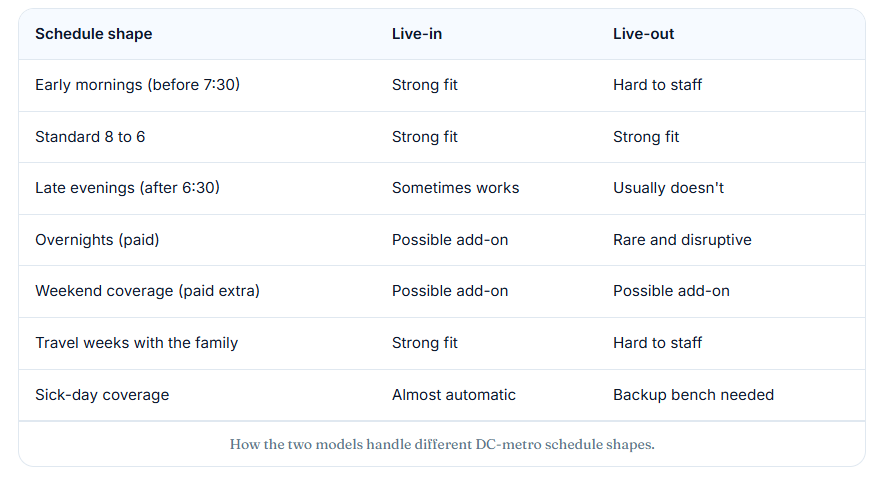
Live-in shines on the morning bookend. The hour between 6 a.m. and 7:30 a.m. is the quiet superpower of the model. Somebody is awake with the kids while you're shaved and dressed. It also handles the awkward 5 p.m. to 6:30 p.m. transition gracefully because she's already in the rhythm of the house. The model breaks when the family expects her to absorb the unscheduled evenings too. The third Monday in a row when one parent is stuck downtown and the other is at a school event becomes a hard conversation in month four if the scope wasn't written down.
Live-out shines when the schedule is regular. Same hours every weekday, predictable hand-off, weekend belongs to the family. The model breaks when the schedule is actually a moving target dressed up as regular. Late dinners that bleed past 6:30, a 5:45 a.m. flight twice a quarter, school strike days nobody saw coming. The live-out who agreed to 7:30-to-6 hates being asked to flex twenty minutes early three times a week.
Family-fit considerations the floor plan won't tell you
Privacy comfort. Some families feel relaxed with another adult in the house at 9 p.m. Some don't. Be honest before week one, not in month two.
Kid temperament. Some kids settle faster when the caregiver leaves at 6. Others find the continuity of having her in the house calming. The toddler who spent the day with her doesn't always want to say goodbye at dinner.
Marital rhythm. Live-in changes the texture of evenings. Quiet pre-bedtime dinners shift. If that quiet is load-bearing for your relationship, live-out protects it.
The shared kitchen. Live-in means a third grocery list, a third dietary preference, a real conversation about what's communal and what isn't. The household runs better with that conversation written down.
Guest dynamics. When grandparents visit, where does the live-in go? Does she still have the suite, or does she relocate? Settling that on day one prevents the awkward Thanksgiving conversation.
Common transition challenges in the first 90 days
Whichever model you pick, the first 90 days have the same shape. Week one is shadowing. Day one she watches the parent run the morning. Day three she runs it with the parent reachable but not present. Week two the kids start asking about her by name. Week six is usually where the small frictions surface. A habit that grates, a routine that needs tweaking, a misread expectation about the dishwasher. Families who run a 20-minute weekly check-in catch those frictions in week six. Families who don't run them hear about them in month four when she's already drafting a resignation letter.
Live-in placements add one extra wrinkle. The first month of sharing a kitchen and a bathroom takes adjustment on both sides. We coach families through it: written house norms (laundry rotation, fridge zones, who restocks the kid snacks), and a Sunday five-minute reset if the week ahead has anything unusual. Boring documentation prevents loud disagreements.
How the placement actually runs
Whichever model you pick, the hiring loop is what protects you. We run background checks, in-home trial days, and real reference calls before anyone gets keys. Two former employers, one personal, one professional. The trial day is the single best signal. You see how she handles a tantrum at 4 p.m., not how she handles an interview at 10 a.m. Most families who skip the trial day are the ones we hear from in week six wanting a re-placement.
The agency side matters here. Our DC nanny placement service covers the seven-step vetting front to back, and for families considering a household manager or estate manager along with the nanny, our household staffing options cover the broader team. Those are different roles than a senior nanny. Don't pile them onto one person.
Backup coverage and the bench you build in month one
Every nanny gets sick. Every nanny takes vacation. The placements that hold up plan for it on day one. Live-in families need a sitter bench too. When the live-in takes her week off, the morning still happens. Live-out families need it for sick days and the school strike day nobody saw coming. Two or three sitters who've already been to the house, met the kids, and know the routine. Build that bench in the first month. The first time you actually need backup, you don't want to be running a fresh interview with a fever in the next room.
How to actually pick
Sit down with your partner and answer four questions, in order. One. Do we have a real private bedroom and bath, with a door that closes? Two. Are our hours irregular enough that morning coverage before 7 is a weekly need? Three. Do the kids settle better when the house is just us in the evening? Four. How comfortable are we, honestly, with a third adult in the house from Sunday night through Friday afternoon?
If your answers tilt toward space-yes-and-early-mornings-yes-and-comfort-yes, you're a live-in family. If they tilt toward house-already-full-and-evenings-matter, you're live-out. The fit difference is much bigger than most families assume going in.
If you want a hand running this for your specific Silver Spring house, that's what we do. We've placed nannies and household staff across the DC metro since 2017. Email us at Hello@districtsitter.com with your hours, your kids' ages, and whether you've got a real guest suite. We'll come back with a candidate slate that fits and a scoping conversation about which model your week is actually built for. For families who'd like to read more about how the search and screening process actually runs, our Washington DC hiring process guide walks through intake, vetting, and the first 90 days.