
Temporary Nanny in Bethesda, MD: How to Bridge the Gap When Your Regular Childcare Falls Through
Your nanny gave notice. Or you're heading back to work in three weeks and the full-time search isn't done yet. Or your regular person is out for six weeks and your backup plan just fell through.
These are the moments when families in Bethesda start asking about temporary nanny arrangements, and realize they don't have a clear picture of how they actually work. Here's what temporary care looks like, what it costs, and what to sort out before the first day.
Quick answer: Temporary nanny placements typically run one to twelve weeks. They cover the same responsibilities as a regular nanny, childcare, routine management, light household tasks tied to the kids. Rates in Bethesda run $25 to $38 per hour depending on experience and household complexity. Shorter arrangements are usually hourly; longer ones shift to weekly with guaranteed hours.
What Temporary Nanny Arrangements Actually Cover
A temporary placement is exactly what it sounds like, a vetted nanny who steps in for a defined period, covering the same scope as a permanent hire. That includes childcare, daily routines, school pickups and drop-offs, meal prep for the kids, and light household tasks directly tied to the children. The difference from a permanent placement is the term.
You both know it's a defined window. This isn't the same as emergency backup care or a one-night babysitter. Temporary nannies build a real routine with your kids, learn your household's patterns, and provide continuity during a transition period. That continuity matters, especially for toddlers and preschool-age kids who do better with a consistent face than with a rotation of new people.

The Situations That Actually Call for a Temp
Most families come to temporary arrangements through one of a handful of situations:
Your permanent nanny gave notice and the replacement search is in progress, typical gap is 4 to 8 weeks
Your maternity leave is ending and you want to test a schedule before committing to a full-time hire
Your permanent nanny is taking medical leave or an extended vacation
You're moving to Bethesda and need coverage while your regular childcare network catches up
A family emergency or sudden work travel created an unexpected gap
Each of these situations has a different urgency level and a different definition of 'good enough.' A 2-week gap while your regular nanny is on vacation has different requirements than a 10-week bridge while you complete a permanent search. Start with the actual end date in mind, even if it shifts.
Duration and What Structure Usually Looks Like
Temporary placements run anywhere from one week to about three months, though most fall in the two-to-six week range. The structure looks similar to a permanent arrangement during that window, set days, set hours, a consistent schedule the kids can rely on. What shifts is the notice period and the expectation around extensions.
For anything over four weeks, it's worth thinking about what happens if the arrangement needs to extend. The better temp arrangements build in a clear checkpoint at the midway point where both sides decide whether the end date changes. Kids adjust to transitions faster when they see it coming.
What a Short-Term Agreement Should Cover
You still need paperwork, even for a two-week arrangement. The basics: defined start and end dates, hours per day, schedule by day of week, the core duties, what's off-limits, the pay rate and payment schedule, and the notice period if either side needs to end it early. The off-limits list matters more in short-term arrangements than families expect.
A temp is getting up to speed quickly. Writing down the household rules, no screens before nap, always check car seat clips, the oldest kid's allergy, removes ambiguity that can cause real problems. Three paragraphs on paper before day one is better than a phone call at 2pm on day three.

What Temporary Nanny Care Costs in Bethesda in 2026
Bethesda runs at the higher end of the DC metro market. Expect to pay more than the city average because the candidate pool in suburban Maryland for experienced temp work is smaller and demand is consistent year-round.
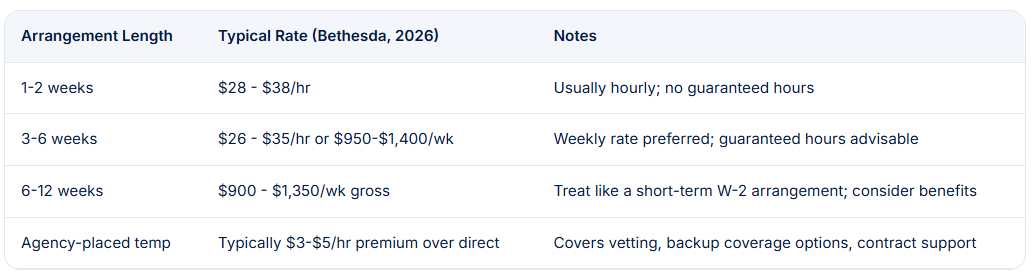
One thing families underestimate: guaranteed hours. If you commit to a 40-hour week and end up only needing 32, you typically still owe the 40. That's standard for a reason, it protects a temporary caregiver who turned down other work to be available for you. Worth building into your budget from the start.
When a Temporary Arrangement Becomes the Right Long-Term Hire
It happens more often than you'd think. A temp comes in, fits the household well, the kids adjust, and at week four the family asks whether she's interested in staying. That's a completely legitimate outcome, but it means shifting the arrangement from short-term to permanent, which means a real contract, W-2 payroll, benefits, and a guaranteed hours structure.
If you're in a temporary arrangement and thinking about extending it into something permanent, talk to whoever placed the nanny before you have that conversation directly.
There are usually contract terms about transition fees and process. Handle it correctly and everyone comes out well. If you're starting a permanent search at the same time as a temp arrangement, a DC nanny placement service can run both tracks in parallel so the gap closes at the right time. For families also thinking about household structure longer-term, the live-in vs. live-out nanny decision guide covers what that permanent setup looks like.
Gaps in childcare coverage are stressful. The good news is that temporary arrangements in Bethesda work well when they're set up with the same care as a permanent placement, clear scope, real paperwork, and a vetted candidate. Skip the setup and the gap gets worse, not better.